Updated August 2026
If you are upgrading the return pump in a beginner all-in-one aquarium, my first choice is usually the AquaIllumination Axis 40—or the Axis 20 or 90 when one of those sizes fits the system better. Its narrow vertical footprint works in rear filtration chambers where many traditional pumps simply will not fit.

AquaIllumination Axis 40
The vertical body saves precious floor space, the DC motor is quiet and adjustable, and Mobius lets me program it alongside compatible AI and EcoTech equipment. I currently use Axis pumps on both my HelloReef tank and my JBJ RF-45.
Best for: Compact all-in-one aquariums with narrow rear return chambers.
Four return pumps I have actually used
There is no universal winner because the correct pump has to fit the chamber, connect to your tubing, overcome the height it must push water, and still land inside the flow range your aquarium can handle. These four cover the beginner setups I encounter most often.
| Pump | My pick for | Power | Control | Published output | Main trade-off |
|---|---|---|---|---|---|
| AI Axis 40 | Tight AIO rear chambers | DC | Mobius / myAI app | Up to 400 GPH | Needs careful, regular cleaning |
| IM MightyJet Desktop | Simple onboard control | DC | Included controller | Up to 326 GPH | Only 18 inches of published max head |
| Sicce Syncra SDC 3.0 | More head pressure and flow | DC | Controller, Wi-Fi, ContrALL | 260–800 GPH | Large footprint and premium price |
| Sicce Syncra Silent 1.5 | Affordable AC reliability | AC | Manual flow adjustment | 357 GPH | More vibration and no speed controller |
Measure the return chamber before you buy
A return pump that looks perfect on paper is useless if it does not fit your aquarium or connect to its plumbing. Check these four things against the current manufacturer specifications.
Measure the chamber’s width, length, and usable height. Leave room to remove the pump for cleaning.
Measure the vertical distance the pump must lift water. Actual flow falls as head pressure increases.
Confirm the pump outlet and the aquarium’s tubing size. Include any adapter space in your measurements.
More output is not automatically better. A controllable DC pump gives you room to tune the return flow after installation.
How I chose these return pumps
I have used every pump family on this list. My ranking is based on the realities that matter after installation: fitting it into the aquarium, hearing it run every day, cleaning it, and trusting it to keep moving water.
I use Axis pumps in my HelloReef and JBJ RF-45 systems. The narrow shape and Mobius control are excellent, although I have had reliability and cleaning issues.
I have used these in Innovative Marine systems and like the included controller. The deciding question is whether the pump and its limited head height fit your installation.
I trust Sicce pumps, and the SDC adds Wi-Fi control, useful alerts, and a temperature reading for systems that need more power.
I have owned dozens of these AC pumps. They are affordable and extremely dependable, but I still prefer the quiet adjustability of DC when the budget allows.
1. AquaIllumination Axis 40
My experience: I currently run Axis pumps on my HelloReef and JBJ RF-45 tanks. I like them enough to rank the Axis first, but I have also encountered a few reliability issues and small internal pieces that require attention during cleaning.
A narrow, programmable pump for tight rear chambers
Up to approximately 400 GPH
2.44-inch diameter × 6.625 inches tall
- The vertical design uses far less chamber floor space than a traditional horizontal return pump.
- Mobius or myAI control provides schedules, feed mode, and output calibration.
- The published maximum head is approximately 9 feet, giving it more installation flexibility than many tiny desktop pumps.
- The Axis family includes the smaller Axis 20 and larger Axis 90, so choose the model around the aquarium’s required flow and available space.
What to know first: The bottom of a rear filtration chamber is where detritus collects, and the Axis sits vertically in that debris. Remove and clean it regularly. Pay attention to every small internal part as you disassemble it; pieces that look insignificant may be essential to the pump operating correctly.
My verdict: This is my first choice when a beginner all-in-one tank needs a compact, quiet, controllable upgrade. I would not treat it as maintenance-free.
2. Innovative Marine MightyJet Desktop

My experience: I have used MightyJet pumps in Innovative Marine aquariums and have never had a problem with them. I like that I can set the pump directly from its included controller without relying on Wi-Fi.
Quiet, straightforward control when the pump fits
326 GPH
18 inches
- Nine flow settings let you tune a steady stream or pulsing sine mode from the controller.
- A 10-minute feed mode and controller lock are useful without adding another phone app.
- Multiple included barbed adapters make it easier to match common AIO tubing sizes.
- The DC motor is much quieter than the small AC pumps many aquariums include from the factory.
What to know first: The 3.7 × 2.5 × 3.4-inch body will not fit every narrow rear chamber, and the published 18-inch maximum head makes this a desktop AIO pump—not the right choice for lifting water from a cabinet sump to a display tank.
My verdict: If your chamber fits it and your return outlet is close enough, the MightyJet is the simplest DC option here. Install it, use the controller, and skip the wireless setup entirely.
3. Sicce Syncra SDC 3.0

My experience: I have used the Syncra SDC line and trust Sicce’s pump quality. This is not the smallest or prettiest option, but it is functional, quiet, and far more capable when water must travel farther.
A larger smart DC pump with temperature monitoring
260–800 GPH
7.5 feet
- Use the included controller or the Sicce ContrALL app for flow adjustment, pause modes, schedules, and alerts.
- An integrated temperature probe shows the passing water temperature and can send out-of-range notifications.
- The pump can run submerged or externally and includes flexible hose fittings.
- The five-year warranty requires online registration.
What to know first: At 7.3 × 2.5 × 3.8 inches, the SDC 3.0 is much longer than the nano pumps above. Measure carefully. It is more appropriate for a larger rear chamber or sump than a tiny beginner desktop aquarium.
My verdict: Choose it when you need more usable head pressure, higher output, and app-based alerts. For a small AIO tank, it is usually more pump—and more money—than necessary.
4. Sicce Syncra Silent 1.5
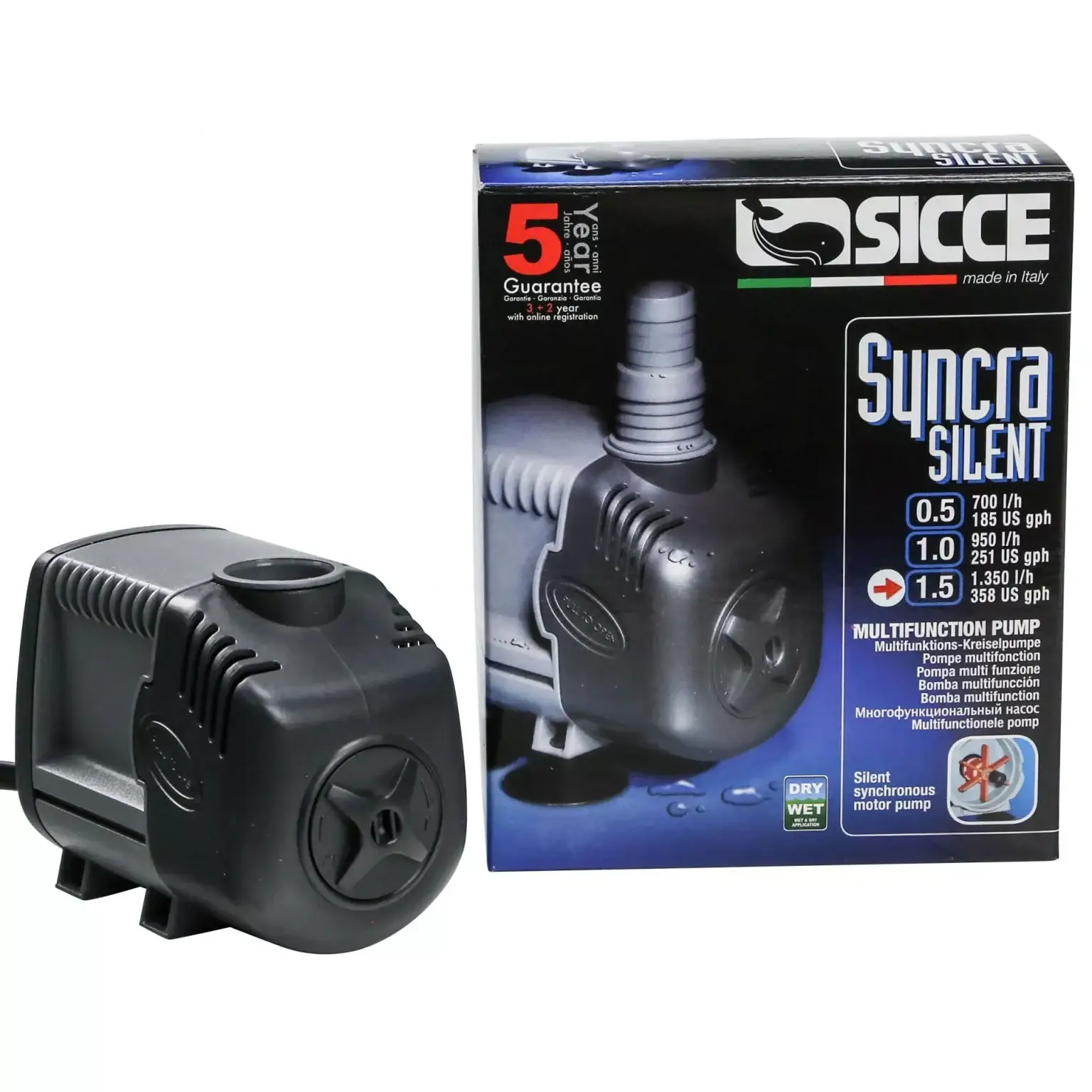
My experience: I have probably owned 30, 40, or 50 Syncra Silent pumps over the years. I cannot remember one giving up on me. They are affordable workhorses.
Proven reliability without electronic controls
357 GPH
6 feet
- The Syncra Silent family runs from small utility pumps to much larger return pumps; choose the model using Sicce’s current flow and head specifications.
- The 1.5 can run submerged or in-line and has a manually adjustable inlet.
- Rubber feet help reduce vibration.
- The motor warranty extends to five years with registration, while the impeller has shorter coverage.
What to know first: This is an AC pump, so its impeller runs at one electrical speed. The manual dial restricts flow rather than electronically slowing the motor. Keep the pump and tubing from touching the aquarium walls, or vibration can transfer into the glass and become much louder.
My verdict: Buy the appropriate Syncra Silent size when affordability and proven reliability matter more than silent DC operation or electronic control. It is the only AC pump family I am recommending here.
For most display tanks, I prefer DC
The silence and adjustability are worth paying for when the pump runs beside you all day.
A DC return pump lets you tune the actual speed, usually runs with less noticeable vibration, and makes feed or maintenance modes easy. An AC pump costs less and may be extremely reliable, but it normally runs at one speed and can transfer more vibration into the aquarium.
Neither power type excuses poor installation. Keep the pump off the glass when possible, use the included rubber feet, prevent rigid tubing from transmitting vibration, and clean the impeller before buildup turns a quiet pump into a noisy one.
Which saltwater aquarium return pump should you buy?
Start with physical fit, required head height, and tubing—not a tank-gallon label. Then choose the control style you want. On a phone, swipe inside the table to see every column.
| Pump | Best for | Avoid it when | Power and control | Published max head | Price level | Current option |
|---|---|---|---|---|---|---|
| AI Axis 40 | Narrow AIO rear chambers | You will not clean the chamber and pump carefully | DC; Mobius / myAI | Approximately 9 ft | Midrange | Check BRS price |
| IM MightyJet Desktop | Simple onboard DC control | Your installation needs more than 18 inches of head | DC; included controller | 18 in | Midrange | Check BRS price |
| Sicce Syncra SDC 3.0 | Higher flow, head pressure, and smart alerts | Your return chamber is short or narrow | DC; controller and Wi-Fi | 7.5 ft | Premium | Check BRS price |
| Sicce Syncra Silent 1.5 | Affordable AC reliability | Vibration or electronic speed control matters most | AC; manual restriction | 6 ft | Budget | Check BRS price |
Specifications, model ranges, included fittings, prices, and availability can change. Confirm the current pump dimensions, flow curve, head rating, and tubing sizes before ordering.
Saltwater aquarium return pumps: common questions
What return pump do you recommend for a beginner all-in-one aquarium?
My first choice is usually the AI Axis model that fits the tank’s flow requirements. Its narrow vertical footprint is especially helpful in small rear filtration chambers. Measure before ordering and confirm the current manufacturer specifications.
Is a DC return pump better than an AC return pump?
I prefer DC for most display aquariums because it is adjustable and usually much quieter. AC pumps can cost less and be extremely dependable. My AC recommendation is the Sicce Syncra Silent family.
How many gallons per hour should my return pump provide?
Do not buy from the unrestricted GPH number alone. Follow the aquarium and pump manufacturer’s guidance, account for head height and plumbing resistance, and choose a controllable pump when possible so you can tune the final installed flow.
Why is my return pump noisier than expected?
Check whether the pump, tubing, or fittings are touching the aquarium walls. Clean the impeller and intake, reinstall the rubber feet, remove trapped air, and confirm the pump is not being forced to operate outside its intended installation.
How often should I clean a return pump?
Inspect it during routine maintenance and clean it before mineral deposits, algae, or detritus noticeably reduce flow or add noise. Pumps sitting at the bottom of an AIO rear chamber may need more frequent attention because debris settles there.
Finish the circulation plan
A return pump moves water through the filtration system; it does not replace the broad, changing flow corals need inside the display. Compare my wavemaker recommendations, then use the Maintenance Guides to keep both pumps clean and reliable.