

Saltwater aquarium reference
Recommended Saltwater Parameters for Reef Tanks
Written by Matthew Zahler
Updated September 2026.
What should your saltwater aquarium’s water parameters actually be? When you’re starting out, all the different tests and recommended numbers can feel like a lot. But you don’t need to make this more complicated than it is. Below, I’ve put together my recommended water parameters for a reef tank, along with what I test, how often I test it, and what I would do if a reading was off.
After more than a decade of keeping saltwater aquariums, the biggest lesson I’ve learned is that stability and trends matter more than a perfect reading. You don’t need to chase every number on this page. What you do need is a consistent testing routine, a journal to record your results, and the patience to make changes slowly. Pay attention to how your animals look, too. If your readings are consistent and your tank looks healthy, that’s far more useful than hitting an exact number.
Use this guide as a starting point, not a reason to panic every time a test result moves a little. If something looks wrong, test again before you start adding products or making big adjustments. The goal is to understand what’s happening in your tank so you can take care of it with confidence.
Disclosure: This guide contains affiliate links. If you buy through them, My First Fish Tank may earn a commission at no extra cost to you.
The Quick Answer: My Working Reef-Tank Ranges
These are the ranges I use as a practical starting point for a mixed beginner reef. The animals you keep, your salt mix, and the instructions for your test method still matter.
| Parameter | Practical target range | My usual target | How often I check |
|---|---|---|---|
| Salinity | 34–36 ppt | 35 ppt | Weekly and before water changes |
| Specific gravity | About 1.024–1.026 | About 1.026 | Use one salinity unit consistently |
| Temperature | 77–79°F | 77–78°F | Monitor continuously |
| pH | About 7.8–8.3 | A stable value above 8.0 | Trend it; do not chase one reading |
| Alkalinity | 7–10 dKH | About 9 dKH | Weekly; more often while dialing in dosing |
| Calcium | 400–450 ppm | About 420 ppm | Every 1–2 weeks |
| Magnesium | 1,250–1,350 ppm | About 1,300–1,350 ppm | Every 2–4 weeks |
| Nitrate | 3–5 ppm | Below 15 ppm, never zero | Weekly |
| Phosphate | 0.01–0.10 ppm | Detectable and generally below 0.10 ppm | Weekly |
| Ammonia / nitrite | Undetectable after cycling | Zero on a reliable test | During cycling or troubleshooting |
What I Actually Test on My Own Aquariums
I do not test every parameter every day. I monitor temperature continuously, check salinity at least weekly, and test alkalinity, nitrate, and phosphate every week because those numbers help me see whether the aquarium is changing.
I test calcium occasionally and magnesium less frequently. During a new cycle, I test ammonia and nitrite. After the cycle is established, I only return to those tests when I am troubleshooting an unexpected problem.
1. Salinity: Measure It Before You Correct Anything Else
Evaporation removes freshwater and leaves salt behind, so salinity rises unless you replace evaporated water with fresh RO/DI water. A water change can also move salinity if the new batch does not match the aquarium.
I use a refractometer with 35 ppt calibration fluid. I previously used a digital salinity tester, but after it eventually gave me incorrect readings—even after calibration—I returned to the refractometer. It is simple, dependable, and easy to verify.
- Calibrate the instrument with the correct calibration fluid.
- Measure freshly mixed saltwater before it enters the aquarium.
- Replace evaporation with fresh RO/DI water, not saltwater.
- If a result looks wrong, confirm it before changing the tank.
Related guides: RO/DI systems, salt mixes, and salinity testers.

BRS Refractometer with Calibration Fluid
Measure your tank’s salinity and freshly mixed saltwater, using the included calibration fluid to check your refractometer.
2. Temperature: Stability Matters More Than Picking the Perfect Degree
I normally keep my aquariums around 77–78°F. The acceptable range is broader, but rapid changes are what I work hardest to prevent. A heater controller gives me an independent cutoff and an alarm if the water gets too warm or too cold.
In Palm Desert, cooling matters too. A fan can lower aquarium temperature through evaporation, but it increases top-off demand. Keep the aquarium away from direct sun and HVAC vents, use a reliable thermometer, and make sure the heater cannot touch anything that traps heat.
See the aquarium heater guide and controller guide.

HelloReef Stick-On Thermometer
This simple outside-the-glass thermometer lets you check your aquarium’s temperature at a glance.
3. Alkalinity: My Most Useful Reef-Tank Trend
Alkalinity is the reef parameter I watch most closely once corals begin consuming carbonate. It helps buffer pH and supplies carbonate used by calcifying organisms. I aim for about 9 dKH, but the exact number matters less than keeping it stable inside a sensible range.
If alkalinity is moving, test at the same time of day and look at several results before changing a dose. When I use kalkwasser, it adds calcium and alkalinity together and can raise pH, but it is not a universal fix. Any dosing method must be matched to measured consumption.
My preferred test is the Hanna alkalinity checker because it gives me a clear digital result. Whatever test you use, follow its timing and sample-volume instructions exactly.

Hanna HI772 Alkalinity dKH Checker
Measure alkalinity directly in dKH with the HI772 checker and keep a record of changes over time.
4. Calcium and Magnesium: Important, but Usually Slower-Moving
Stony corals, coralline algae, clams, and other calcifying organisms use calcium and carbonate to build calcium-carbonate structures. Magnesium helps keep calcium and alkalinity available in seawater rather than precipitating too easily.
I generally target 400–450 ppm calcium and 1,250–1,350 ppm magnesium. In my tanks, alkalinity usually shows changing consumption sooner, so I test calcium less often and magnesium less often still. A new salt mix, a major dosing change, or an unexpected alkalinity problem is a good reason to check both.
Do not correct magnesium, calcium, and alkalinity simultaneously based on one surprising test. Confirm salinity first, repeat the test, and then adjust one thing at a time.

Salifert Calcium Test Kit
Check calcium with this manual test kit when monitoring coral growth or making changes to your dosing routine.
5. pH: Investigate the Cause Instead of Pouring In a Buffer
pH changes naturally during the day as photosynthesis and respiration change carbon dioxide levels. A closed home with people and pets can hold more CO₂ and push aquarium pH lower. That is common in my own home during periods when the windows stay closed.
A reading around 7.8–8.3 can be workable when it is stable, but a sudden change deserves attention. Before dosing anything, confirm the test, check alkalinity, improve gas exchange, and compare indoor and outdoor air conditions. Opening a window or improving surface agitation can sometimes explain more than a bottle of buffer.
I do not recommend blindly dosing a pH buffer. It can move alkalinity while leaving the underlying CO₂ problem unchanged.
6. Nitrate and Phosphate: Nutrients Should Be Controlled, Not Erased
I aim for 3–5 ppm nitrate in a beginner mixed reef, but really, as long as it’s stable and stays below about 15–20 ppm, I don’t consider it a big deal. Higher nitrate levels can make nuisance algae growth more likely, so keep an eye on the trend and how your tank looks.
For phosphate, I like 0.01–0.10 ppm, but definitely not zero. You don’t want zero nitrate or zero phosphate. Stability is much more important than hitting an exact number, so test consistently, record your results, and make adjustments slowly.
- Confirm an unexpected result before changing filtration.
- Remove trapped detritus and correct overfeeding before adding aggressive chemical media.
- Start conservatively with GFO or another phosphate remover.
- Do not make nitrate and phosphate corrections on the same day unless there is an urgent reason.
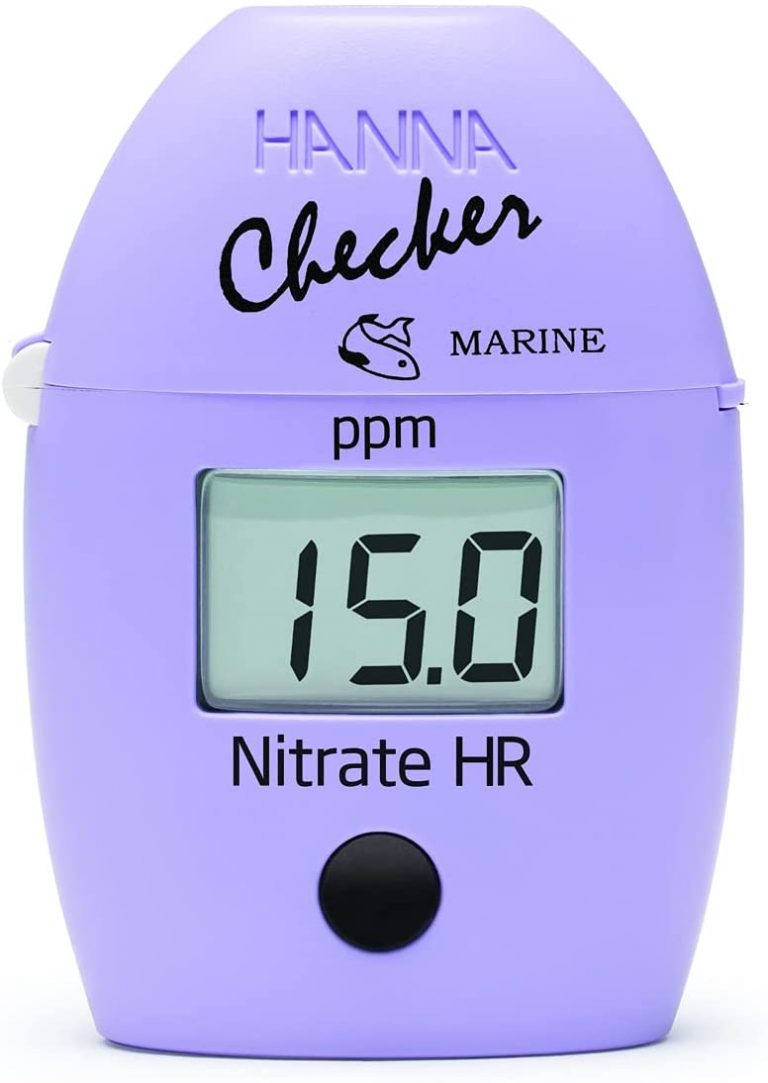
Hanna HI782 High Range Nitrate Checker
Get a digital nitrate reading with the HI782 high-range checker for your regular reef-tank testing routine.

Hanna HI713 Low Range Phosphate Checker
Measure phosphate with the low-range HI713 checker and record the results to follow your nutrient trends.
7. Ammonia and Nitrite: Cycling and Troubleshooting Tests
I test ammonia and nitrite while cycling a new aquarium. Once the biological filter is established, both should be undetectable on a reliable hobby test. I do not keep testing them every week in a stable, stocked aquarium.
If ammonia appears unexpectedly, protect the animals first. Confirm the result, check for a dead animal or interrupted filtration, increase aeration, and prepare a water change. The correct response depends on the reading, pH, temperature, and livestock, so do not treat one color-chart result as the whole diagnosis.
For this stage, the API Saltwater Master Test Kit remains my practical beginner choice because it covers ammonia and nitrite without requiring expensive single-parameter instruments.

API Saltwater Liquid Master Test Kit
Check ammonia, nitrite, nitrate, and high-range pH with this kit for cycling a new saltwater aquarium.
A Testing Schedule That Beginners Can Actually Maintain
| When | What to test | Why |
|---|---|---|
| Continuously or daily glance | Temperature; equipment alarms | Catches heater, cooling, and power problems quickly |
| Weekly | Salinity, alkalinity, nitrate, phosphate | Shows the trends I use most often |
| Every 1–2 weeks | Calcium | Confirms balanced major-element consumption |
| Every month | Magnesium | Useful when dosing, salt mix, or precipitation changes |
| During cycling | Ammonia and nitrite | Tracks the biological filter becoming established |
| When troubleshooting | Repeat the relevant test and verify salinity | Prevents a bad test from creating a bad correction |
Watch the Water-Testing Walkthrough
This video shows the practical testing routine behind the numbers in this guide. Use it to compare technique, then follow the exact instructions supplied with your own test kit.
What to Do When a Parameter Is Out of Range
- Don’t panic. Try to figure out what the cause is. Is there a dead fish or snail? Have you forgotten to change out the mechanical filtration?
- Repeat the test. Check the reagent, sample volume, timing, and instrument calibration. If just one parameter seems really wrong, repeating the test is advisable because you may have just made a mistake during testing.
- Perform a water change. If things are out of whack in your aquarium, performing a large 30–50 percent water change will go a long way to getting things back on track.
For a routine correction, use my step-by-step saltwater water-change guide. To choose the equipment, compare the eight testing tools I actually use.
Dosing Recommendations
If water changes are no longer keeping up with what your corals consume, these are two dosing options I recommend. You do not need to start dosing just because you have a reef tank. Test first, record the results, and only add what your aquarium actually needs.
Kalkwasser and All-For-Reef are alternatives to traditional two-part dosing, not the two separate parts of one system. Choose a method, follow its instructions, and adjust slowly based on your test results.

BRS Pharma Kalkwasser Powder
Kalkwasser supplies calcium and alkalinity together and can also raise pH. Mix the powder with RO/DI water according to the BRS instructions, then dose the settled, clear solution slowly.
Do not add dry powder directly to the aquarium. Monitor pH and alkalinity carefully to avoid overdosing.

Tropic Marin All-For-Reef
All-For-Reef is an all-in-one liquid that supplies calcium, alkalinity, magnesium, and trace elements. It is an option if you prefer a single solution rather than separate calcium and alkalinity bottles. Follow the label and use your alkalinity trend to guide gradual dose adjustments.