Updated August 2026
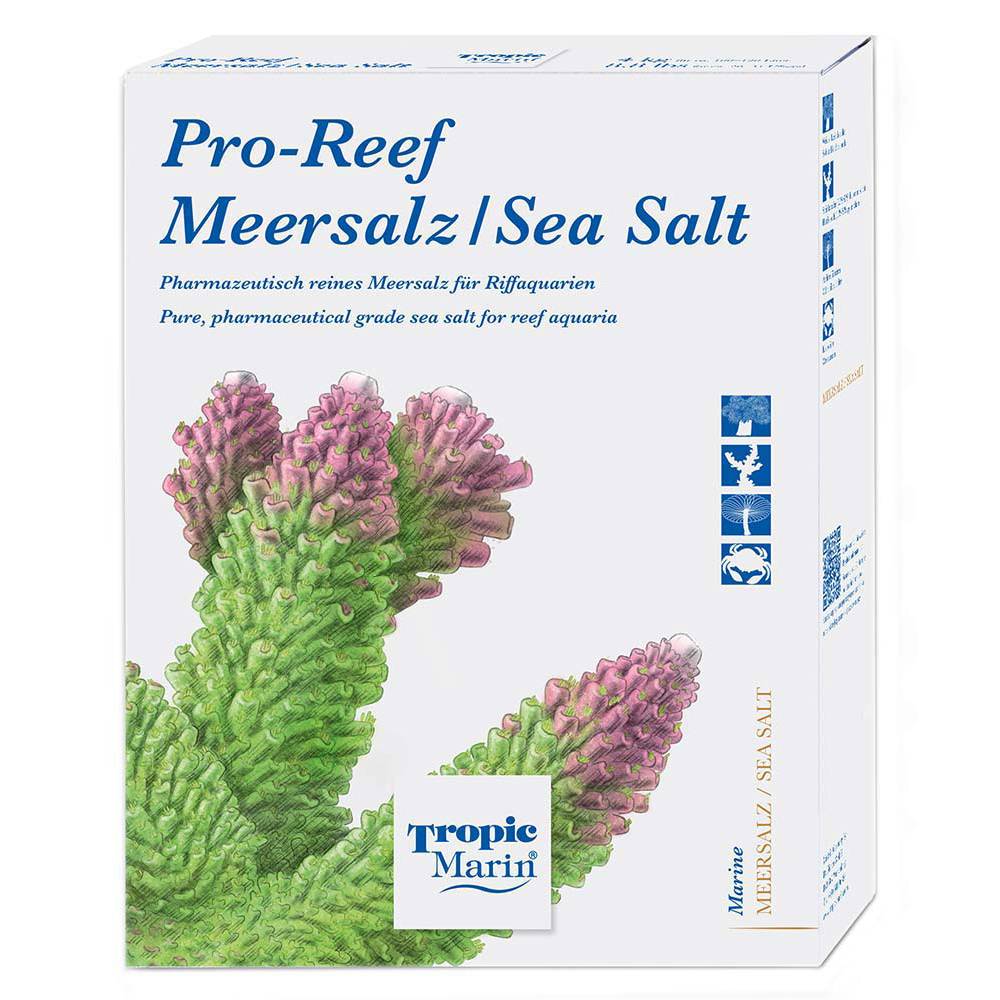
If you want my direct answer, buy Tropic Marin Pro-Reef Salt. I have used it for years in every one of my aquariums because it mixes cleanly, stays stable in storage, and does not leave the slimy brown residue I have dealt with from other salt mixes.

Tropic Marin Pro-Reef Salt
I mix roughly 50 gallons at a time and may store that saltwater for months. In about five years, I have only needed to clean the inside of my 50-gallon mixing drum once. That clean mixing and storage stability are why I keep buying it.
Best for: Reef keepers who want a premium salt for clean mixing, large batches, and stored saltwater.
The four reef salt mixes I recommend
All four can make usable saltwater. The real difference is what happens before that water reaches the aquarium: how cleanly the salt dissolves, how much residue it leaves in the mixing container, whether the mixed water stores well, and how much you want to spend.
| Salt mix | My pick for | Mixing experience | Parameter style | My experience |
|---|---|---|---|---|
| Tropic Marin Pro-Reef | Best overall | Very clean | Near-natural alkalinity | My everyday salt for years |
| NYOS PURE | Best clean-mixing alternative | Very clean and quick-dissolving | Near-natural ranges | Used several times |
| Instant Ocean Reef Crystals | Best value | More residue in storage | Enriched reef formulation | Personally used |
| Red Sea Salt — blue bucket | Best moderate-alkalinity Red Sea option | Simple regular-salt choice | About 8 dKH at 35 ppt | Personally used |
Clean mixing matters when you store saltwater
If you mix five gallons and use it immediately, residue may be a minor annoyance. If you make 50 gallons at a time, it becomes a maintenance decision. A dirty mix coats the pump, heater, tubing, and storage container. Then you have to empty the entire system and scrub it.
That is why Tropic Marin Pro-Reef wins for me. I can mix a large batch, stop circulating it after it is fully dissolved, and keep the water available for later water changes. NYOS PURE is the closest alternative on this list. Reef Crystals works, but I would expect to clean the storage container more often.
How I chose these salt mixes
I have personally mixed and used every salt in this guide. I ranked them by the things I notice in real maintenance: residue, storage behavior, consistency, ease of use, and price—not by whichever bucket has the most aggressive coral-growth language on the label.
I use it in all my tanks and have mixed large stored batches with remarkably little residue.
I have used it several times, found that it mixes cleanly, and know many experienced BRS reef keepers who swear by it.
It is the affordable, established workhorse. My trade-off is the dirtier mixing-container residue.
I recommend the regular blue-bucket formula, not Coral Pro, because beginners do not need the purple bucket’s elevated parameters and stricter handling.
1. Tropic Marin Pro-Reef Salt
My experience: This has been my salt for years. I use it across all my aquariums and trust it for 50-gallon batches that may sit in storage.
The salt I buy for my own tanks
7 dKH · 440 ppm calcium · 1350 ppm magnesium
Clean large-batch mixing and storage
- It dissolves quickly and clearly without coating my storage drum in sludge.
- The lower, near-natural alkalinity fits the way I prefer to run reef aquariums.
- The mixed saltwater remains useful without continuous aeration or circulation in my storage setup.
- It is made from pharmaceutical-grade materials and contains the major, minor, and trace elements expected in a reef salt.
What to know first: It is a premium-priced salt. Its approximate alkalinity is also lower than some reef mixes, so match your water-change water to the parameters you actually maintain.
My verdict: If you want me to make the decision for you, this is the salt mix I would buy.
2. NYOS PURE Salt Mix

My experience: I have used NYOS PURE several times and found that it mixes cleanly. It is also a favorite among experienced reef keepers I worked with at Bulk Reef Supply.
Clean, fast, and consistent
7.5–8.9 dKH · 415–450 ppm calcium · 1320–1400 ppm magnesium
Premium clean mixing with batch documentation
- NYOS says the fine salt dissolves in about five minutes at room temperature.
- The formula avoids organic additives and is designed not to leave insoluble white or black particles.
- Each batch is ICP controlled, with batch information available from the package.
- The near-natural parameter ranges make it appropriate for both small and large water changes.
What to know first: It is another premium option, and the published parameter values are ranges rather than a single guaranteed number. Test the first batch from a new box or bucket before making a large water change.
My verdict: Choose NYOS PURE when you want a clean-mixing premium salt but do not want Tropic Marin Pro-Reef.
3. Instant Ocean Reef Crystals

My experience: Reef Crystals works and has worked for decades. It is usually the salt I point to when the purchase price matters more than keeping the mixing station spotless.
The affordable, proven workhorse
Enriched reef mix with added calcium and trace elements
Budget-focused water changes
- It is widely available and commonly among the most affordable reef salt options.
- The formula has been used successfully for a very long time.
- It includes added calcium and other components aimed at reef aquariums rather than fish-only systems.
- It makes sense when you mix smaller batches and use them promptly.
What to know first: In my experience, it mixes noticeably dirtier than Tropic Marin or NYOS. If you store large batches, expect to clean the container, pump, and heater more often.
My verdict: Buy Reef Crystals when you want the tried-and-true budget choice and do not mind extra mixing-station maintenance.
4. Red Sea Salt — Blue Bucket

My experience: If you want Red Sea, buy this regular blue-bucket salt—not the purple Coral Pro bucket with elevated alkalinity, calcium, and magnesium.
Moderate parameters without the Coral Pro complication
7.7–8.1 dKH · 415–430 ppm calcium · 1230–1290 ppm magnesium
Reef keepers who want regular Red Sea salt
- The approximate 8 dKH alkalinity is much more moderate than Coral Pro’s published 12.3–12.7 dKH.
- The formula uses naturally harvested salt from the Red Sea with added minor and trace elements.
- It is designed to dissolve quickly and does not require choosing an elevated-parameter strategy.
- The blue packaging makes it easy to distinguish from the purple Coral Pro product.
What to know first: Do not accidentally buy Coral Pro because the names look similar. The purple product has significantly elevated foundation elements and is not the beginner recommendation in this guide.
My verdict: This is the Red Sea option I would choose when you want moderate, near-natural parameters and straightforward mixing.
Do not switch salt mixes carelessly
A water change should make the aquarium more stable, not surprise it. Before switching brands, mix a small batch and test salinity, alkalinity, calcium, and magnesium. Compare those numbers with the aquarium and with the old salt mix. If the difference is substantial, transition with smaller water changes rather than making one enormous change.
Always add salt mix to RO/DI water, never pour water onto a pile of dry salt, and never mix new salt directly in an aquarium that contains animals. Follow the manufacturer’s current directions for the exact product and package you buy.
Which reef salt mix should you buy?
Choose Tropic Marin Pro-Reef if you want my actual salt. Choose NYOS PURE when you want another premium clean-mixing option. Choose Reef Crystals to spend less, or the regular Red Sea blue bucket when you want Red Sea without Coral Pro’s elevated parameters. On a phone, swipe inside the table to see every column.
| Salt mix | Best for | Avoid it when | Mix cleanliness | Storage fit | Price level | Current option |
|---|---|---|---|---|---|---|
| Tropic Marin Pro-Reef | My best overall recommendation | The lowest purchase price matters most | Excellent in my experience | Excellent for my large stored batches | Premium | Check BRS price |
| NYOS PURE | Premium clean-mixing alternative | You want the established budget workhorse | Excellent | Designed for longer storage | Premium | Check BRS price |
| Instant Ocean Reef Crystals | Affordable, proven reef salt | You store large batches and hate residue | Messier in my experience | Better when used promptly | Budget | Check BRS price |
| Red Sea Salt — blue bucket | Moderate parameters in the Red Sea line | You accidentally mean purple Coral Pro | Good | Regular salt formulation | Midrange | Check BRS price |
Published parameters, package sizes, prices, and availability can change. Verify the current label and test a freshly mixed batch before it goes into the aquarium.
Reef salt mix: common questions
What is the best salt mix for a reef tank?
My top recommendation is Tropic Marin Pro-Reef. I use it in all my own tanks because it mixes cleanly and has worked extremely well for the large batches of saltwater I store.
Why does a clean-mixing salt matter?
Residue collects on the storage container, pump, heater, and tubing. If you make large batches or store saltwater, a cleaner salt can save a meaningful amount of maintenance. It matters less when you mix a small bucket and use it immediately.
Can mixed saltwater be stored?
That depends on the exact formula. In my system, Tropic Marin Pro-Reef has remained stable for months without continuous mixing after it fully dissolves. NYOS also describes PURE as suitable for longer storage. Follow the current manufacturer instructions and keep the container clean and covered.
Is Instant Ocean Reef Crystals a good reef salt?
Yes. It is an established, affordable reef mix that has worked for decades. My main complaint is that it leaves more residue in a mixing and storage container than Tropic Marin Pro-Reef or NYOS PURE.
What is the difference between Red Sea blue bucket and purple bucket salt?
The regular blue-bucket Red Sea Salt has much more moderate foundation elements. At 35 ppt, Red Sea publishes alkalinity of 7.7–8.1 dKH for the regular salt and 12.3–12.7 dKH for purple-bucket Coral Pro. I recommend the regular blue product for beginners.
Should I choose a salt with elevated alkalinity, calcium, and magnesium?
Not automatically. A salt mix should match the way you maintain the aquarium. Large parameter differences during a water change can create instability. I prefer near-natural or moderate salt parameters and handle supplementation separately when the tank actually consumes those elements.
Do I need to heat new saltwater while mixing it?
Follow the instructions for the salt you buy. Temperature affects salinity readings, and the replacement water should not cause a major temperature swing when it enters the aquarium. Measure salinity with a calibrated device before every water change.
Can I mix salt directly in an aquarium with fish or coral?
No. Mix salt completely in a separate container of RO/DI water, verify salinity and temperature, and only then add the finished saltwater to the aquarium.
Make the water before you need it
Start with the RO/DI filter buying guide, confirm the finished water with the saltwater testing setup I use, and use the reef salt mix calculator to estimate how much dry mix your batch requires. You can also return to the complete Gear Guide library.