If you want my direct answer, buy the BRS handheld refractometer bundle with 35 ppt calibration fluid. I own and have used every salinity tester in this guide, but the inexpensive handheld refractometer is the one I still use today.

BRS Refractometer With Calibration Fluid
It is inexpensive, fast, durable, and easy to verify. Mine has stayed dependable for years, and unlike an electronic meter, it does not need batteries or recurring calibration packets.
Best for: Nearly every beginner who wants one trustworthy everyday salinity tool.
The four salinity testers I recommend
All four can provide useful readings when used correctly. The meaningful differences are how you read them, what they require for calibration, how fragile they are, and whether the extra cost of a digital display improves your actual maintenance routine.
| Tester | My pick for | Calibration | Temperature handling | Main trade-off |
|---|---|---|---|---|
| BRS handheld refractometer | Best overall | 35 ppt fluid included | Automatic temperature compensation | You read a line through the eyepiece |
| Tropic Marin hydrometer | Best mechanical reference | None | Specified at 77°F | Extremely fragile and needs depth |
| Hanna HI98319 | Best pocket digital option | 35 ppt packets | Automatic compensation | Recurring calibration and trust checks |
| Milwaukee MA887 | Best premium digital bench tester | Automatic with purified water | Temperature-compensated scales | Expensive and bulky |
Calculate the salt mix for your next batch
Once you have a reliable salinity tester, enter your water volume and target salinity to estimate how much dry salt mix to add—then confirm the finished batch with the tester before it reaches the aquarium.
How I chose these salinity testers
I have owned and used all four. I ranked them by the experience of actually making saltwater and maintaining aquariums—not by which display looks the most advanced.
Mine has been stable, quick, and uncomplicated. I verify it with the included 35 ppt fluid when needed.
I keep it in my 50-gallon saltwater container as a simple mechanical visual reference.
I loved its speed until mine eventually produced incorrect readings even after calibration, which cost it my trust.
It is the premium digital choice here, but for my routine it is more equipment and expense than I need.
1. BRS Refractometer With Calibration Fluid
My experience: This is the salinity tester I use today. I have found it remarkably stable, and I do not remember the last time mine needed a meaningful calibration adjustment.
The tool I think almost everyone should buy
1.000–1.070 specific gravity
35 ppt fluid, pipette, case, screwdriver, and cloth
- Place a few drops on the prism, close the cover, wait briefly for the sample and tool to equalize, then read the boundary through the eyepiece.
- The included reference fluid lets you check the instrument near the salinity where you actually run a reef tank.
- It needs no batteries, proprietary packets, or electronic probe care.
- Automatic temperature compensation helps, but a tool and sample at a stable indoor temperature still make the process more repeatable.
What to know first: Calibrate it with the included 35 ppt solution when you first receive it. Check it again if it is dropped, stored somewhere with a major temperature change, or gives a reading that does not make sense. Do not calibrate this bundle with RO/DI water.
Watch: what salinity is and how I test it
This is my existing salinity walkthrough, now placed with the refractometer I actually recommend.
My verdict: I honestly do not see a reason for most beginners to spend more. Buy this, verify it once, keep the prism clean, and use it consistently.
2. Tropic Marin High Precision Hydrometer

My experience: I still use this in my 50-gallon mixing drum. It gives me a quick visual reference without batteries, software, or calibration solution.
Accurate, old-school, and extremely fragile
1.021–1.031 SG, 0.0001 resolution
77°F / 25°C
- The handmade glass instrument never needs recalibration.
- Its 14.25-inch length requires a deep sample where it can float freely without touching the sides or bottom.
- It is an excellent independent reference for checking a refractometer or electronic meter.
- Read it at eye level only after the water is still and the bobbing has settled.
What to know first: The glass is very thin and can break easily. Use a deep bucket or mixing container, handle it gently, and interpret readings at the specified 77°F reference temperature or use the manufacturer’s correction guidance.
Watch: how I use the Tropic Marin hydrometer
This video shows why the hydrometer works best in a deep, permanent saltwater-mixing station.
My verdict: Buy it as a precise mechanical reference when you have a deep mixing container and can protect fragile glass. I would not make it the only everyday tester for a nano aquarium.
3. Hanna HI98319 Marine Salinity Tester

My experience: I used and loved this tester for years. Then mine began giving incorrect readings even after calibration. I made large salt-mix adjustments before discovering the tester was wrong, and I eventually threw it away.
Fast digital convenience with recurring verification
PPT, PSU, specific gravity, and temperature
Automatic single-point at 35 ppt
- The pocket-size probe returns salinity and temperature quickly.
- Automatic temperature compensation works from 5–50°C.
- It includes four 35 ppt calibration packets and uses a common CR2032 battery.
- It is much easier to read than the fuzzy boundary some people see through a traditional refractometer.
What to know first: Calibration is part of ownership. BRS says Hanna recommends monthly calibration—or more often with frequent use. I personally calibrated frequently and still learned to verify any suspicious result before changing a large batch of saltwater.
Watch: my Hanna salinity tester walkthrough
Here is my hands-on look at using the Hanna HI98319 Marine Salinity Tester.
My verdict: Choose it when a compact digital readout matters enough to accept ongoing calibration and independent verification. It worked well for me for years, but it is no longer my first choice.
4. Milwaukee MA887 Digital Seawater Refractometer
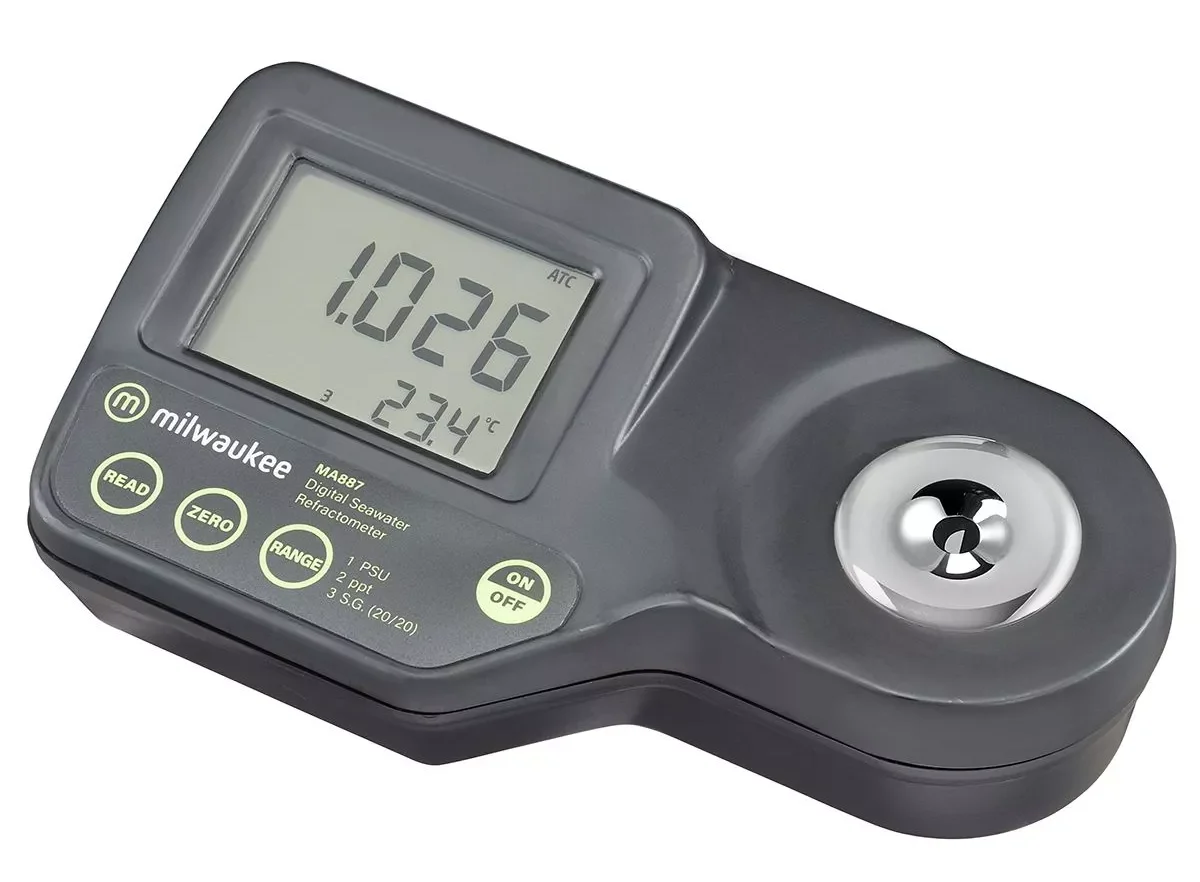
My experience: I have owned and used the Milwaukee. It is a serious, easy-to-read digital refractometer, but I personally reach for the much simpler handheld refractometer instead.
The high-end choice when you want a benchtop display
PSU, PPT, specific gravity, and temperature
7.5 × 4 × 2.6-inch, 9V-powered meter
- Add the sample to the well and read the result on a large digital display.
- All three seawater scales are temperature compensated.
- Calibration is automatic and uses distilled or RO/DI water according to the current guidance.
- The two-year manufacturer warranty is longer than the one-year coverage listed for the other electronic options here.
What to know first: Premium does not mean you can stop verifying readings. The published accuracy is ±2 ppt or ±0.002 SG. The meter is also much larger and more expensive than the handheld tool that already handles my everyday needs.
Watch: my Milwaukee digital seawater refractometer walkthrough
Here is my hands-on look at using the Milwaukee MA887 Digital Seawater Refractometer.
My verdict: Buy it when you deliberately want a premium digital bench refractometer and do not want to interpret an optical line. For most beginners, it is overkill.
Never correct salinity from one questionable reading
A precise-looking number can still be wrong.
If a reading would make you add a large amount of salt or fresh water, stop and verify it. Clean the tool, repeat the test, check calibration, and compare against a second trusted method when possible. My failing Hanna tester taught me that the expensive mistake is not owning the wrong gadget—it is trusting one surprising number enough to make a huge correction.
Make salinity changes slowly when livestock is present. Evaporation raises salinity because only fresh water leaves the tank; replace evaporation with purified fresh water, not saltwater.
Which aquarium salinity tester should you buy?
Buy the BRS refractometer bundle if you want my actual recommendation. Add the Tropic Marin hydrometer when you want a mechanical reference in a deep mixing station. Choose the Hanna for pocket-size digital convenience, or the Milwaukee when you specifically want a premium benchtop digital refractometer. On a phone, swipe inside the table to see every column.
| Tester | Best for | Avoid it when | Calibration burden | Reading style | Price level | Current option |
|---|---|---|---|---|---|---|
| BRS handheld refractometer | My best overall recommendation | You cannot comfortably read an optical boundary | Low; verify with 35 ppt fluid | Eyepiece | Budget | Check BRS price |
| Tropic Marin hydrometer | Independent mechanical reference | You lack a deep container or safe storage | None | Floating glass scale | Midrange | Check BRS price |
| Hanna HI98319 | Portable digital readings | You dislike calibration packets and verification | Recurring | Pocket LCD | Premium | Check BRS price |
| Milwaukee MA887 | Premium benchtop digital testing | You want the best value or smallest tool | Automatic, but still verify | Large LCD | Highest | Check BRS price |
Specifications, included accessories, calibration guidance, prices, and availability can change. Follow the current manual for the exact instrument you buy.
Saltwater aquarium salinity testers: common questions
What is the best salinity tester for a saltwater aquarium?
My first choice is the BRS handheld refractometer bundle with 35 ppt calibration fluid. It is affordable, fast, durable, and easy to verify near normal reef-tank salinity.
How often should I calibrate a refractometer?
Check a new refractometer before relying on it. Recheck after a drop, major storage-temperature change, or suspicious reading. Mine has remained stable for years, but the included 35 ppt fluid makes verification quick.
Should I calibrate a seawater refractometer with RO/DI water?
Not this BRS optical bundle. Its current instructions say to use the included 35 ppt fluid and not RO/DI water. The Milwaukee digital refractometer has different instructions and uses distilled or RO/DI water, which is why you must follow the manual for the exact tool.
Is a hydrometer accurate?
The Tropic Marin High Precision Hydrometer is a precise reference instrument when it floats freely, the water is still, and temperature is handled correctly. Swing-arm plastic hydrometers are a different category and are not among my four recommendations.
What temperature should the Tropic Marin hydrometer water be?
Its published specification is referenced at 77°F or 25°C. If your sample differs meaningfully, follow Tropic Marin’s current temperature-correction guidance rather than pretending temperature does not matter.
Is a digital salinity tester more accurate?
Not automatically. Digital tools are easier to read, but they still have published accuracy limits, calibration requirements, contamination risks, and the possibility of failure. Choose digital for convenience, not because a screen guarantees truth.
Should salinity be measured in PPT or specific gravity?
Either can work when you understand the unit and use it consistently. Natural-strength seawater is commonly discussed around 35 ppt, which corresponds roughly to 1.026 specific gravity at typical reef temperatures. Do not confuse a change in SG with the same numerical change in ppt.
What should I do if two salinity testers disagree?
Do not adjust the aquarium yet. Clean both tools, confirm the sample and temperature, recalibrate or verify them according to their manuals, and use a trusted reference method. Resolve the measurement disagreement before changing the water.
Use the reading to make better water
Compare the RO/DI systems I recommend, choose a mix in the reef salt buying guide, and review my recommended saltwater parameters. You can also return to the complete Gear Guide library.